

Portable Appliance Testers (PAT)
Test Faster. Work Smarter. Stay Fully Compliant.
If you run a test & tag business, manage workplace compliance, or service multiple high-risk sites, having the right PAT tester helps you work faster, safer and with complete confidence.
We stock all Australia's leading brands of portable appliance testers and cover every level of testing - from simple pass/fail units designed for basic compliance through to advanced models. Whether you're a new user or an experienced electrician, if you want reliable, professional-grade results, we've got the right PAT tester for you.
Every model is selected for accuracy, durability and long-term reliability in real-world electrical safety environments, and all are fully compliant with AS/NZS 3760.
With unlimited lifetime support from our expert team, you can choose the right tester with total confidence, knowing you'll always have guidance when you need it.
-
 Free Bonus Pack
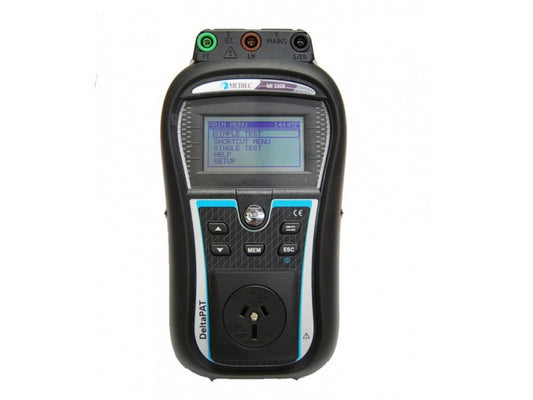
Metrel DeltaPAT 3309 BT
Regular price $1,879.00Regular priceUnit price per$1,978.90Sale price $1,879.00 -
 10% off
Metrel DeltaPAT Starter Kit
Regular price $1,900.00Regular priceUnit price per$2,115.00Sale price $1,900.00Sale -
 Top 5
Top 5Seaward Primetest Pro
Regular price $2,859.00Regular priceUnit price per -
Wavecom TnT EL
Regular price $877.80Regular priceUnit price per -
 Free Bonus Pack
Metrel DeltaPAT Go Print Kit
Regular price $3,645.40Regular priceUnit price per$4,345.00Sale price $3,645.40 -
Trisan S8 DL
Regular price $1,685.00Regular priceUnit price per -
 Contact Us to Order
Trisan S8 DL Starter Pack
Regular price $1,775.00Regular priceUnit price per -
Kyoritsu 6205
Regular price $1,342.00Regular priceUnit price per -
Kyoritsu 6205 Starter Pack
Regular price $1,430.00Regular priceUnit price per -
 8% off
DeltaPAT 3309 Tradie Kit
Regular price $2,105.00Regular priceUnit price per$2,277.00Sale price $2,105.00Sale -
DeltaPAT & Godex Printer
Regular price From $2,869.90Regular priceUnit price per -
DeltaPAT & Godex Complete Kit
Regular price From $3,785.00Regular priceUnit price per$4,054.60Sale price From $3,785.00Sale -
Metrel Alpha EE 3340
Regular price $3,390.00Regular priceUnit price per -
 7% off
Delta Pro Print Pack
Regular price $4,178.90Regular priceUnit price per$4,472.60Sale price $4,178.90Sale -
 Free Bonus Pack
Seaward Primetest 125 EL
Regular price $877.80Regular priceUnit price per$989.00Sale price $877.80 -
 Free Bonus Pack
Seaward PAC3760 DL
Regular price $1,208.90Regular priceUnit price per -
PAC3760 DL Printer Pack
Regular price $2,473.90Regular priceUnit price per -
PAC3760 DL & 3-Phase Kit
Regular price $2,530.00Regular priceUnit price per -
Seaward Primetest Elite+
Regular price $4,180.00Regular priceUnit price per -
Seaward Primetest Pro Kit
Regular price $4,389.00Regular priceUnit price per -
Primetest Elite+ XL Kit
Regular price $7,698.90Regular priceUnit price per -
Wavecom TnT EL Starter Pack
Regular price $966.00Regular priceUnit price per -
 Free Bonus Pack
Wavecom TnT RCD
Regular price From $1,053.80Regular priceUnit price per -
 Contact Us to Order
Wavecom TnP-500
Regular price $3,627.80Regular priceUnit price per -
Wavecom TnT 3PL Lite
Regular price $6,721.00Regular priceUnit price per -
Wavecom TnP 3PLM
Regular price From $9,073.90Regular priceUnit price per -
 10% off
Wavecom TnP Prime
Regular price From $4,837.80Regular priceUnit price per$5,376.80Sale price From $4,837.80Sale -
Wavecom TnT Titan
Regular price From $1,537.80Regular priceUnit price per -
Metrel Alpha EE 3340 Print Kit
Regular price $6,160.00Regular priceUnit price per -
Wavecom TnT Titan DT Kit
Regular price $4,222.90Regular priceUnit price per -
Trisan S8 Starter Pack
Regular price $1,179.00Regular priceUnit price per -
Kyoritsu 6205PRO
Regular price $1,972.00Regular priceUnit price per


Which PAT Tester Is Right for You?
Entry-level testers are ideal for small businesses and low-volume testing, providing fast, reliable pass/fail checks for basic compliance.
Mid-range testers add features such as automated test sequences, insulation resistance, leakage testing, and optional scanning tools—making them suitable for general commercial testing.
High-performance models go further with Bluetooth connectivity, app integration, instant label printing, data storage for thousands of test results, and advanced reporting software—perfect for contractors and large organisations handling higher test volumes.
If you work in construction, workshops, hire fleets or industrial settings, you may need a PAT tester with the right functionality combination.
- Bluetooth-enabled PAT Testers – ideal for wireless workflows & app connectivity
- PAT Testers With Printers – complete systems with label printers included
- PAT Testers With RCD Testing – for workplaces using portable RCDs
- PAT Testers With 3-Phase Testing – perfect for industrial equipment
- PAT Testers With Data Logging – for professional reporting & large client sites
Quick recommendation: If you test more than 40–50 appliances per week, consider mid-range or advanced models.
Further Reading & Useful Resources
Looking for more guidance before you decide? Explore our expert resources:
PAT Tester Reviews »
In-depth reviews of popular models, covering usability, durability, and value for money.
Top 5 PAT Testers 2025 »
A curated list of the best testers this year, with pros and cons to help you compare.
PAT Tester Buyer's Guide »
Everything you need to know about features, standards, and choosing the right tester.
PAT Tester Comparison »
Side-by-side breakdown of key models so you can quickly see the differences.
PAT Tester Support Guides »
Helpful resources, user manuals, software downloads and interactive videos.
Need Assistance?
Call us on 1300 656 938